How private do you really want to be? That’s not a rhetorical flourish — it’s the decision that determines which tools you should use and why. For privacy-focused users in the US, where regulatory pressure, surveillance-capable networks, and aggressive analytics firms create a dense threat environment, the architecture and operational choices of a wallet matter as much as whether it supports XMR, BTC, or LTC. This explainer walks through the mechanics that give Cake Wallet its privacy properties, compares the trade-offs against alternatives, and offers practical heuristics for when it helps — and when it won’t.
Short version: Cake Wallet bundles strong device-level protections, network anonymity options, and privacy-aware protocol features (notably Monero and Litecoin MWEB support). But no wallet is a panacea; privacy depends on the stack: device, network, provenance of coins, and operational discipline. Read on for the how, the limits, and a few real-world decision rules you can reuse.
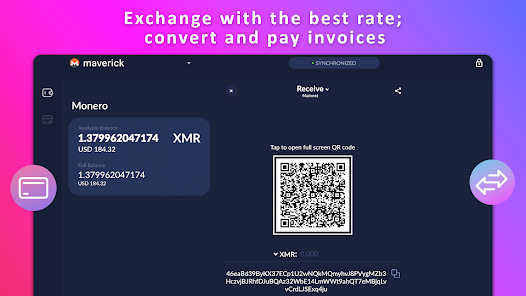
How Cake Wallet constructs privacy: layers and mechanisms
Think of privacy as layered defenses: device security, key custody, network anonymity, coin-level protocol features, and transaction construction. Cake Wallet addresses each: it uses device-level encryption and hardware-backed protections (Secure Enclave on iOS, TPM on Android) to shield keys at rest, supports biometric and PIN locks for immediate local access control, and runs as a non-custodial, open-source client so private keys never leave your device. That foundation reduces the risk of developer-side leakage and makes remote server compromise irrelevant to your private keys.
On networking, Cake Wallet offers a Tor-only mode, I2P proxy support, and custom node selection. Those features matter because many privacy leaks begin with IP address correlation: connecting to default public nodes ties a device’s network identity to wallet activity. Tor and I2P are different trade-offs — Tor is more mature and often faster for interactive use in the US; I2P can be preferable if you want more decentralization in the routing layer. Allowing custom nodes gives advanced users a way to run and point to their own full nodes, which substantially improves privacy and censorship resistance.
At the protocol level Cake Wallet supports Monero-specific features (subaddresses, background sync, retention of the private view key on-device) and Litecoin’s MWEB optional privacy layer. For Bitcoin, the wallet implements privacy tools like Silent Payments, PayJoin v2, UTXO coin control, and batching. Cross-chain swaps are handled via a decentralized routing system called NEAR Intents, which finds market-maker liquidity without a central custodian — an important design because centralized swap services often require KYC or create custody risk.
What this design gets right — and where it can break down
Strengths are concrete. Keeping the private view key on-device for Monero prevents the common mistake of exposing view-only access to servers. Hardware integrations (Ledger, Cupcake air-gapped option) let you separate signing from an online device. Zero telemetry and a formal no-data-collection stance are meaningful in practice: developers cannot stitch transaction data to device identifiers because they do not receive them.
But there are limits and trade-offs. Device-level encryption assumes the device OS and firmware are trustworthy; a compromised OS or an advanced attacker with device access can still exfiltrate seeds or PINs. Tor-mode helps hide network-level metadata, but it cannot obfuscate everything: timed, volume, and on-chain analytics still provide linkage signals. MWEB on Litecoin improves confidentiality of amounts and some linkability, yet it is optional and interoperates imperfectly with exchanges and services that still require transparent on-chain history.
There are also protocol-specific friction points. A current, practical limitation: Zcash migration from Zashi wallets is not seamless — Zashi seed phrases are incompatible because of differing change address handling, so users must manually transfer ZEC funds to a newly created Cake ZEC wallet. That illustrates a broader reality: different wallet implementations and chain quirks produce usability gaps that can force less-private workflows (manual transfers, exchange mediation) if not handled carefully.
Comparing alternatives: where Cake Wallet fits the landscape
If you’re weighing options, consider three archetypes: single-coin native privacy wallets, multi-currency privacy-focused clients, and hardware-only solutions.
– Native privacy wallets (Monero GUI, for example) usually provide the deepest protocol-level control and can be run with your own node; they are the most rigorous for high-threat users but often lack convenience and multi-coin support. Cake Wallet offers many Monero privacy features while also supporting many other coins — a trade-off favoring usability over maximal monoculture rigor.
– Multi-currency clients (mobile-first apps and browser extensions) provide convenience and on-device key custody for many assets. Cake Wallet sits here but differentiates by emphasizing Tor/I2P, strict no-telemetry, hardware wallet integration, and advanced BTC privacy tools. That makes it attractive for users who want cross-asset privacy without siloing each coin into a different app.
– Hardware-only solutions (air-gapped devices, dedicated signers) maximize key security. Cake Wallet integrates with hardware wallets like Ledger and Cupcake, combining the best of both worlds: secure signing and flexible software-based privacy tooling. The trade-off: hardware is safer for keys but adds operational friction (carrying devices, extra steps for signing), which some people will avoid, reducing actual privacy in practice.
Decision heuristics — when to choose Cake Wallet
Here are practical rules you can reuse:
– Use Cake Wallet if you need multi-coin capability with strong privacy defaults and you value Tor/I2P network anonymity out of the box. The wallet’s combination of Monero features, Bitcoin privacy tools, and Litecoin MWEB support makes it uniquely versatile.
– Prefer native single-coin clients if you need absolute protocol-level control and are willing to run your own full node (e.g., Monero GUI for the highest isolation). Choose hardware + Cake Wallet if you want convenience plus stronger key protection.
– If you plan cross-chain swapping without custody or KYC, Cake Wallet’s NEAR Intents-powered swaps reduce reliance on centralized exchanges, but always check liquidity and slippage for the pairs you care about before transacting.
Operational checklist — reducing the biggest practical risks
Technical features are necessary but not sufficient. For immediate risk reduction, do these five things: enable device hardware encryption and a strong biometric or PIN, use Tor-only mode or route traffic through a trusted proxy, run or point to your own full node when possible, attach a hardware wallet for large balances, and avoid plumbing coins through exchanges that strip privacy (unless you’re willing to accept the trade-off).
If you want to try Cake Wallet specifically for Monero, start by reading a focused guide to subaddresses and view keys: they are the mechanisms that maintain receiver privacy while allowing non-custodial view-only backups. For a quick practical link to learn more about Monero support and how Cake implements it, see this resource: monero wallet.
What to watch next
Policy and technology will move in parallel. Keep an eye on three signals that would materially affect the wallet’s privacy utility in the US: increasing legal pressure on anonymity-enhancing services (which could affect node hosting and public infrastructure), wider adoption of MWEB by exchanges (which reduces friction for private LTC usage), and any shifts in the wallet’s open-source dependency chain or telemetry posture. Each would shift the calculus of operational risk and convenience.
Also monitor how NEAR Intents and decentralized routing evolve — improved liquidity and broader market-maker participation reduce swap slippage and systemic custodial friction, but they depend on network effects and counterparty behavior. If those systems widen, cross-chain privacy-preserving swaps become more usable; if liquidity concentrates, users will face worse rates and potentially more centralized failure modes.
FAQ
Is Cake Wallet fully private by default for Monero, Bitcoin, and Litecoin?
Not absolutely, because privacy is multi-layered. Cake Wallet implements strong defaults (Monero subaddresses, keeping private view keys on-device, Tor/I2P, zero telemetry, MWEB support for Litecoin, and Bitcoin privacy tools). Those defaults significantly improve privacy versus naive wallets, but total privacy depends on your device security, whether you run your own nodes, and how you acquire and spend coins.
Can I migrate Zcash from other wallets into Cake Wallet seamlessly?
No — there is a known migration limitation: Zcash seeds from Zashi wallets are incompatible due to different change-address handling. You must manually transfer funds into a newly created Cake ZEC wallet. That operation is straightforward but breaks an otherwise neat “seed-import” workflow and is a good example of cross-wallet incompatibilities undermining privacy if users resort to exchanges or intermediaries to simplify migration.
Should I always use Tor or I2P with my wallet?
Using Tor or I2P greatly reduces IP-based linkage but brings trade-offs: Tor may introduce latency and some services block Tor exit nodes; I2P has different performance and routing properties. For most US users seeking privacy, Tor is a low-friction default. High-threat users should consider a private node plus Tor for layered defense.